
How to Start a Lawn Mowing Business in Australia (2026 Guide)

Established solo operators earn $70K–$95K net — most quit within 2 years
Know your numbers before you quote your first job⚡TL;DR: Key Takeaways
- You can start a lawn mowing business in Australia for $2,000–$5,000 with basic gear, or $10,000–$20,000 for a proper commercial setup
- A sole operator with an ABN, public liability insurance, and decent equipment can be mowing paying customers within two weeks
- Established solo operators earn $70,000–$95,000 net per year. But most new operators fail within two years because they don't know their true costs
- The difference between the operators who make it and the ones who don't isn't talent with a mower. It's knowing their numbers before they quote
Starting a lawn mowing business in Australia is one of the lowest-barrier entries into self-employment. You don't need a degree, a licence, or a shopfront. You need a mower, an ABN, insurance, and customers.
But "low barrier" doesn't mean easy. The lawn mowing and garden services industry turns over $4.1 billion a year across more than 17,400 businesses. Competition is thick. And the average mowing contractor lasts less than two years.
This guide covers everything you need to go from zero to mowing paying customers: the legal setup, real startup costs, equipment decisions, pricing, finding customers, and the mistakes that sink most new operators before they hit year two.
Can you actually make money mowing lawns?
Yes. But less than you think, and only if you get your pricing right.
A solo operator who's been at it for three years or more typically earns $70,000 to $95,000 net on gross revenue of $90,000 to $125,000. That's solid money for working outdoors with no boss.
But year one looks different. Expect $30,000 to $70,000 in gross revenue while you build a customer base. You're learning your routes, figuring out your costs, and working out which jobs are worth taking. Some weeks you'll earn $1,500. Some weeks, barely anything.
The operators who wash out usually don't fail because they can't mow. They fail because they price by gut feel, don't track their costs, and discover too late that they've been working for minimum wage.
"I don't give a price on the spot, in the past I've under quoted due to a bit of anxiety." — Cameron Grieve, Lawn Care Contractor
We break down the full earnings picture — solo, small team, and multi-crew — in How Much Do Lawn Mowing Businesses Make in Australia?.
What you need before you start
Before you buy a single mower, get the paperwork sorted. It takes a day, costs almost nothing, and keeps you legal from the first job.
Business setup checklist
Register an ABN
Free through the Australian Business Register (abr.gov.au). Takes 10 minutes online. You'll need it for invoicing, opening a business bank account, and registering for GST.
Register for GST (if you'll earn over $75K)
If your turnover will exceed $75,000 in a 12-month period, you must register for GST. Even if you're not sure, register early — it looks more professional on invoices, and you can claim GST credits on equipment purchases. You'll need to lodge a BAS (Business Activity Statement) quarterly.
Get public liability insurance
Non-negotiable. Most councils, real estate agents, and body corporates won't let you on-site without $10 million in public liability cover. A sole operator pays roughly $500–$800 per year, about $10–$15 a week. We cover every policy you need in Lawn Mowing Insurance: What You Need & What It Costs.
Open a business bank account
Keep business money separate from personal. Most banks offer free or low-cost business transaction accounts for sole traders. This makes BAS time a lot easier.
Set up basic accounting
Xero is the standard for Australian small businesses. The cheapest plan handles invoicing, bank feeds, and BAS lodgement. Your accountant will thank you. Budget $25–$50/month.
Get a business phone number
A dedicated mobile number or at minimum a Google Business profile with your existing number. Customers need to be able to find you and call you.
Do you need a licence?
No. Lawn mowing doesn't require a trade licence in any Australian state. However, if you plan to do chemical spraying (weed treatment, fertilising), you'll need a chemical user certificate in most states. Check your state's EPA requirements.
Some councils require you to register as a contractor if you're doing work on council-managed properties. Check with your local council before quoting council work.
Startup costs: the real numbers
How much you need depends on how you want to start. There are three realistic tiers.
Startup Cost Tiers — Lawn Mowing Business
| Setup Level | What You Get | Total Cost |
|---|---|---|
| Budget start | Second-hand push mower, basic trimmer, blower, hand tools | $2,000–$5,000 |
| Professional setup | Commercial walk-behind, quality trimmer, blower, trailer, safety gear | $8,000–$15,000 |
| Full commercial | Zero-turn ride-on, commercial trimmer/blower, enclosed trailer, signage | $15,000–$30,000+ |
Excludes vehicle costs. Most operators already own a ute or van. If you need to buy one, add $10,000–$25,000 for a reliable second-hand ute.
Most successful operators start at the professional level. Budget gear breaks down faster, costs more in maintenance, and slows you down on every job. A commercial walk-behind mower cuts your time per property in half compared to a domestic Bunnings mower.
The full startup cost breakdown
Here's what a professional-level startup actually looks like, line by line:
Detailed Startup Costs — Professional Setup
| Item | Cost Range |
|---|---|
| Commercial walk-behind mower | $1,500–$5,000 |
| Line trimmer (whipper snipper) | $200–$400 |
| Blower | $250–$500 |
| Safety gear (boots, glasses, ear protection, hat) | $150–$300 |
| Hand tools (rake, shovel, broom, fuel cans) | $100–$250 |
| Trailer (6x4 or 8x5) | $1,500–$3,500 |
| Trailer fitout (racks, holders, ramp) | $200–$500 |
| Signage (vehicle + trailer) | $200–$500 |
| Public liability insurance (first year) | $500–$800 |
| Equipment insurance (first year) | $200–$500 |
| ABN registration | Free |
| Accounting software (first year) | $300–$600 |
| Marketing (Google Business, initial flyers) | $100–$300 |
| Total | $5,200–$13,150 |
Second-hand equipment can reduce the total by 30–50%, but factor in higher maintenance costs and shorter remaining life.
Use the Startup Cost Calculator to run the numbers with your actual equipment choices and local costs.
Choosing your equipment
Your mower is your main tool. Get this decision right and everything else is easier.
Commercial vs domestic
This is the first fork in the road, and it matters more than most new operators realise.
Commercial vs Domestic Mowers
| Factor | Domestic (Bunnings-grade) | Commercial |
|---|---|---|
| Purchase price | $300–$800 | $1,500–$5,000 |
| Engine hours before failure | 100–300 hours | 1,000–2,500+ hours |
| Cut width | 16–18 inches | 19–22 inches |
| Cut quality | Adequate for home use | Clean, professional finish |
| Speed | Slow. Fine for your own yard | 2–3x faster on the same area |
| ATO effective life | Not applicable | 2 years (push/self-propelled) |
| Daily workload capacity | 3–5 lawns before overheating | 15–25+ lawns |
A domestic mower doing commercial work will die within months. The engine isn't built for 6+ hours of daily use.
A $300 mower from Bunnings might seem like a smart way to save money. It's not. You'll replace it inside three months of full-time use, and the cut quality will cost you repeat customers. Commercial mowers are built for the job. They're faster, more durable, and a 21-inch commercial deck covers the same lawn in half the time. On 10 lawns a day, that's an extra hour you can bill.
What to buy first
If you're starting with a professional but not full-commercial setup, here's the priority order:
- Commercial walk-behind mower. Your primary tool. Honda, Toro, or Hustler are popular in Australia. Buy the widest cut deck you can afford.
- Commercial line trimmer. Stihl or Husqvarna. Two-stroke, not battery. You need something that runs all day.
- Handheld blower. Same brands. A backpack blower is better for large properties but a handheld is fine to start.
- Trailer. At minimum a 6x4 with a ramp. An 8x5 gives you room to add a ride-on later.
- Safety gear. Steel-cap boots, safety glasses, ear protection, sun hat. Non-negotiable from day one.
New vs second-hand
Second-hand commercial gear can save you 30–50% on the purchase price. The trade-off is shorter remaining life and unknown maintenance history.
If you buy second-hand:
- Check engine hours (most commercial mowers have an hour meter)
- Inspect blade condition and spindle bearings
- Test the self-propel mechanism under load
- Ask about service history — regular oil changes and blade sharpening are good signs
- Factor the remaining life into your cost-per-hour calculation
When to add a ride-on
Not yet. Not until you have enough large properties to justify it.
A ride-on or zero-turn mower costs $6,000–$12,000 and only pays for itself on properties above 400–500 sqm. If most of your early customers are standard suburban blocks with side gates too narrow for a ride-on, you'll be carrying $8,000 of equipment you can't use.
Wait until you have 8–10 large properties on your regular round. Then the maths works.
Setting your prices
This is where most new operators get it wrong. And it's where the difference between a $40,000 year and a $90,000 year lives.
The three ways operators price
- Market rate. "Everyone charges $60, so I charge $60." Problem: you don't know if $60 covers your costs.
- Gut feel. "That looks like a $70 lawn." Problem: your gut doesn't account for travel time, equipment depreciation, or the slope you didn't notice.
- Cost-plus. Start with your true costs, add the margin you want, and that's your price. This is the only method that guarantees you make money on every job.
Your true cost per hour
Most new operators think their costs are just fuel and maybe insurance. In reality, your true cost per hour includes:
- Equipment depreciation (your mower loses value every hour it runs)
- Fuel (mowers, trimmers, blowers, and driving between jobs)
- Maintenance and repairs (blades, belts, servicing)
- Vehicle costs (fuel, rego, servicing, tyres)
- Insurance (public liability, equipment, vehicle)
- Admin (accounting software, phone, business registration)
- Consumables (trimmer line, fuel cans, bin bags)
Add it all up and divide by your billable hours. For most solo operators, the true cost per hour — before paying yourself — is $8–$12 per hour. That's the number ticking away on every property, whether you charge for it or not.
$43/hrAdd the wage you want to earn — say $35/hour — and your minimum charge-out rate is $43/hour. That's your break-even. Every dollar above that is actual profit.
We cover the full cost breakdown with ATO benchmarks in The True Cost of Running a Lawn Mowing Business in Australia.
The pricing formula
Price = (Time on property x Your cost per hour) + Travel cost + Margin
On a standard 300 sqm suburban lawn:
- Time on property: 40 minutes (mow, edge, blow)
- Your cost per hour: $43
- Job cost: $28.70
- Travel cost: $5–$8 (15 minutes at your cost rate)
- Subtotal: $33.70–$36.70
- Add 30% margin: $44–$48
That's your floor. In most suburban areas, you'll charge $55–$80 for this job. The margin above your floor is profit. The key is knowing the floor exists.

Don't want to do the math?
Use our free calculator to work it out in seconds.
Finding your first customers
You don't need a marketing budget. You need 15–20 regular customers to fill your first week. Here's how operators actually get them.
Google Business Profile
Set this up on day one. It's free and it's where most people search for local services. Add your ABN, service area, photos of your work (even if it's your own lawn at first), and ask every customer to leave a review.
Five genuine reviews will put you ahead of most local competitors who never bothered to set one up.
Door knocking and letterbox drops
Old school. Still works. Print simple flyers — your name, phone number, services, ABN, and "fully insured" — and drop them in letterboxes around the suburbs you want to work in. Focus on areas within 10–15 minutes of your home to keep travel costs down.
The conversion rate on letterbox drops is low (1–2%), so drop 500–1,000 to get your first 5–10 customers. At $0.10–$0.20 per flyer, that's $50–$200.
Real estate agents and property managers
This is where the volume is. Property managers need reliable mowers for rental properties between tenants, and for ongoing maintenance on investment properties. They'll want your Certificate of Currency (proof of insurance) before they'll send you a single job.
The pay is often slightly lower than residential, but the volume and consistency make up for it. One good property manager relationship can keep you busy for months.
Word of mouth
Do great work, be reliable, and the recommendations come. This is slow in month one but compounds over time. By year two, most established operators get 50–70% of their new work from referrals.
Facebook and local community groups
Join your local suburb's Facebook group. Don't spam. Answer questions about lawn care. When someone posts "looking for a good mower in [suburb]," be the one who responds. Local Facebook groups are surprisingly effective for trades.
Building efficient routes
Every minute driving between jobs is a minute you're not earning. At $65/hour, a 20-minute drive costs you $21.67 in lost productivity. Do that five times a day and you've burned $108 before lunch.
Route density is everything
The operators clearing $90,000+ build tight geographic clusters: 4–6 jobs within a few kilometres of each other. They mow an entire street, not one house on five different streets.
When you're building your customer base:
- Focus on 2–3 suburbs, not your entire city
- Offer a small discount for customers who refer their neighbours (clustering your work is worth more than the discount)
- Schedule by area — all Monday jobs in one suburb, all Tuesday jobs in another
- Track your drive time for a week. Most operators are shocked at how much time they spend between jobs
Daily capacity
A full-time solo operator doing standard suburban lawns can typically service 8–12 properties per day with efficient routes. That's 40–60 properties per week on a five-day schedule. At an average of $65 per property, that's $2,600–$3,900 per week in gross revenue.
But only if the travel time between jobs stays under 10–15 minutes. Spread your jobs across a 50km radius and you'll do half that.
Running the business
Mowing lawns is the easy part. Running a business while mowing lawns is where it gets hard.
Invoicing and getting paid
Invoice on the day you complete the job. The longer you wait, the longer you wait to get paid. Most residential customers pay within 7 days if invoiced immediately. Let it drag and you'll be chasing payments instead of mowing lawns.
Bank transfers are the standard in Australia. Set up your bank details on your invoice template and make it easy for customers to pay.
GST and BAS
If you're registered for GST, you'll lodge a BAS quarterly. This reports:
- GST collected on your invoices (you owe this to the ATO)
- GST paid on your business expenses (the ATO owes this to you)
- The difference is what you pay or receive
Keep your receipts. Every fuel stop, every blade purchase, every insurance payment — it all reduces your GST liability. Xero makes this straightforward if you keep your bank feeds connected and categorise expenses as you go.
Bookkeeping
Set aside 30 minutes a week to reconcile your bank feed in Xero. Do it weekly and it's easy. Let it pile up for three months and BAS time becomes a nightmare.
If numbers aren't your thing, a bookkeeper costs $50–$150/month and will save you hours of frustration. An accountant for your annual tax return runs $500–$1,500 depending on complexity.
Quoting
The fastest way to win a job is to quote on the spot. Operators who quote in person, on-site, close around 90% of their quotes. Operators who go home, think about it, and email a quote two days later close far fewer.
"The key to winning quotes is to turn up same or next day, quote in person with an on the spot price and you'll win 90% of them." — Paul Luck, Lawn Care Contractor
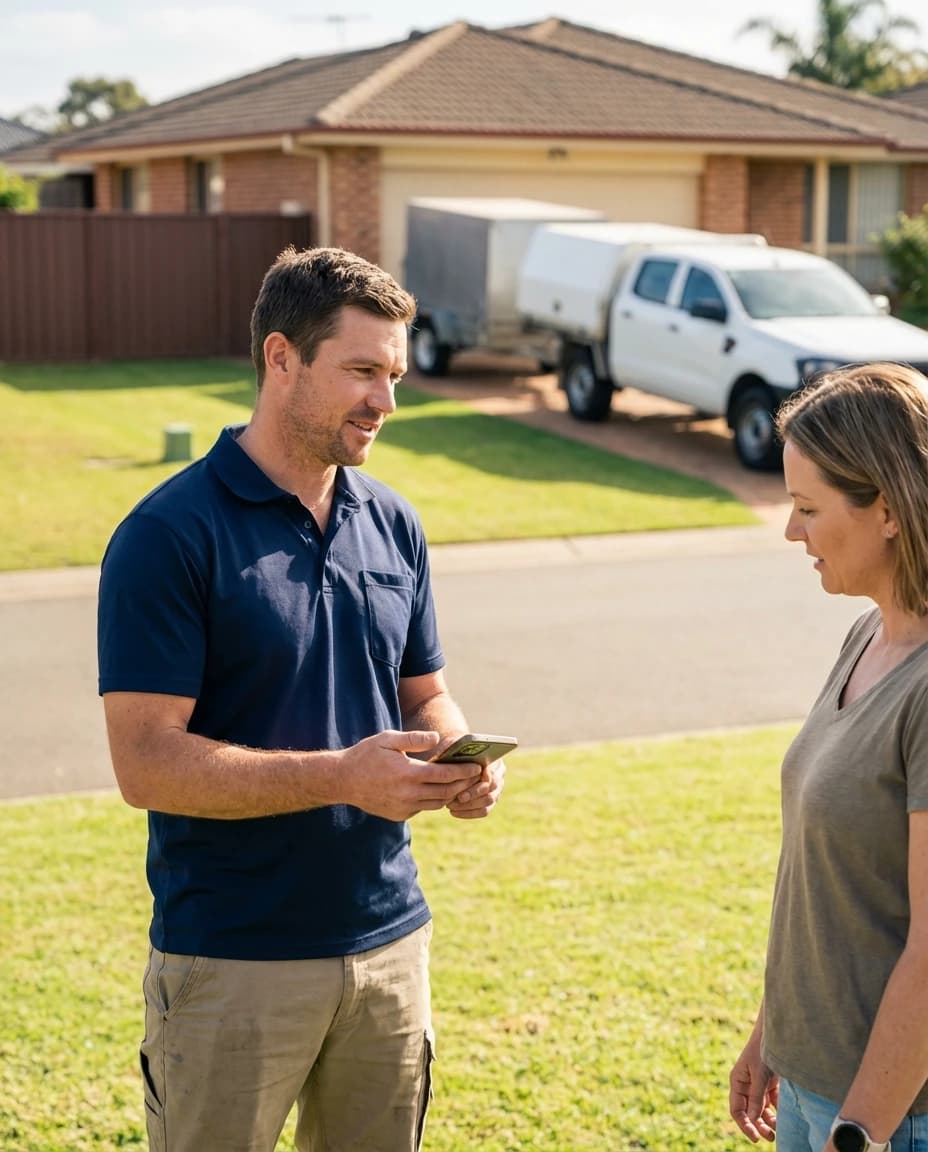
But you can only quote on the spot if you know your numbers. If you're standing on the property trying to guess whether it's a $60 or $80 job, you'll either underprice out of anxiety or delay out of uncertainty. Both cost you money.
Let GUS handle this for every quote.
Know your true costs before you quote. Try it free for 14 days.
Common mistakes that kill new mowing businesses
These are the patterns that show up again and again with operators who don't make it past year two.
1. Pricing off the competition
"Dave down the road charges $50 so I'll charge $50." You don't know Dave's costs. Maybe Dave owns his mower outright and you're on finance. Maybe Dave lives two streets from all his customers and you're driving 25 minutes each way. Maybe Dave is losing money and doesn't know it yet.
Price off your costs, not someone else's.
2. Skipping insurance
It's $10–$15 a week. That's one lawn. One rock through a window, one slip-and-fall claim, one stolen mower — any of these can cost more than years of premiums. Don't skip it. Read the full insurance breakdown.
3. Not tracking equipment depreciation
Your $5,000 mower with a 2-year ATO effective life is costing you $2,500 per year in depreciation. About $5 per hour of use. If that's not in your pricing, you'll feel it the day the machine dies and you need another $5,000 you don't have.
4. Taking every job regardless of location
A single job 30 minutes away from your other work costs you an hour of dead travel time per visit. If it's a fortnightly regular, that's 26 hours a year of unpaid driving for one customer. Be selective about which jobs you take. Route density matters more than customer count.
5. Growing too fast
Adding an employee before you know your own costs doubles the problem. You pick up wages ($25–$35/hour plus super and workers' comp), a second set of equipment, and more vehicle costs. If your solo margins are thin, a second person just scales the losses.
Get your solo operation profitable first. Nail your pricing. Know your cost per hour. Then scale.
Scaling: when to hire your first employee
The maths of hiring is simple but unforgiving.
Your first employee costs roughly $30–$45 per hour fully loaded (base wage + super + workers' comp + extra fuel + equipment wear). They need to generate at least that much in billable revenue per hour, plus cover your overhead allocation, plus leave profit on the table for you.
In practice, your first hire needs to be mowing $50–$60/hour worth of work before they're generating actual profit for the business.
Employee Cost vs Revenue Required
| Cost Component | Per Hour |
|---|---|
| Base wage | $25–$35 |
| Superannuation (11.5%) | $2.90–$4.00 |
| Workers compensation (~2%) | $0.50–$0.70 |
| Extra fuel and equipment wear | $3–$5 |
| Total employee cost | $31–$45 |
| Revenue needed (with margin) | $50–$60+ |
Don't hire until:
- You're consistently turning away work (not just occasionally full)
- Your own cost per hour is calculated and your margins are healthy
- You have enough clustered jobs to fill another person's day without excessive travel
- You can afford 4–6 weeks of wages while the new person gets up to speed
Adding staff changes the business. Revenue can push to $150,000–$300,000+, but your net income as the owner might sit at $70,000–$120,000. Not dramatically more than solo, especially in the first year of scaling.
For more on the earnings at each stage, see How Much Do Lawn Mowing Businesses Make in Australia?.
Key takeaways
Getting started:
- Register an ABN (free), get $10M public liability insurance ($500–$800/year), and open a business bank account. You can be legal and operational in a day.
- Budget $5,000–$15,000 for a professional equipment setup. Buy commercial-grade gear — domestic mowers don't survive full-time use.
Making money:
- Know your true cost per hour before you quote a single job. For most solo operators, it's $40–$45/hour including wages.
- Price off your costs, not the competition. Cost-plus pricing is the only method that guarantees profitability.
- Build route density. Cluster your customers geographically and your daily earnings jump.
Staying in business:
- Track everything: fuel, equipment hours, maintenance costs, drive time. The operators who survive past year two are the ones who know their numbers.
- Don't scale until your solo margins are healthy. Adding staff multiplies your problems if the underlying pricing is wrong.
If you want to stop guessing what each job costs, Gus calculates your true job costs and builds them into every quote automatically. Measure the property, see your real costs, send a professional quote — all in minutes.
Starting a lawn mowing business is straightforward. Running a profitable one takes knowing your numbers. The operators who last aren't better with a mower — they're better with their costs.
More in Business
What Does It Cost to Start a Lawn Care Business? (2026 Breakdown)
Real startup costs for a US lawn care business in 2026. Equipment, insurance, legal fees, and marketing costs, broken down by budget tier so you know exactly what you need.
What Does It Cost to Start a Lawn Mowing Business in Australia?
Real startup costs for a lawn mowing business in Australia: equipment, insurance, registration, vehicle setup. Three budget tiers from $2,000 to $20,000+.
How to Start a Lawn Care Business in the US (2026 Guide)
Step-by-step guide to starting a lawn care business in the US. Equipment costs, legal setup, insurance, pricing, and how to land your first customers. Real 2026 numbers, not motivational fluff.
Lawn Care Insurance: Coverage & Costs for US Operators
General liability, commercial auto, workers comp, equipment coverage — what insurance does a US lawn care business actually need, and what does it cost? Real numbers inside.
Lawn Mowing Insurance: What You Need & What It Costs in Australia
Public liability, equipment cover, income protection — what insurance do you actually need for a lawn mowing business in Australia, and what will it cost? Real numbers inside.
How Much Do Lawn Care Businesses Make in the US?
What do lawn care business owners actually take home? We break down revenue, costs, and profit margins by business size with real industry data, not guesswork.
How Much Do Lawn Mowing Businesses Make in Australia?
Real earnings data for Australian lawn mowing businesses — from solo operators to multi-crew operations. Includes ATO benchmarks, regional rates, and the costs most operators forget.
The True Cost of Running a Lawn Mowing Business in Australia
What does it actually cost to run a lawn mowing business? Equipment, fuel, insurance, depreciation — we break down every dollar so you can quote with confidence.
The True Cost of Running a Lawn Care Business in the US
What does it actually cost to run a lawn care business? Equipment, fuel, insurance, depreciation. We break down every dollar so you can price jobs with confidence.
Stop guessing your costs. Calculate what every job actually costs you.
Try GUS Free for 14 Days